
Introducing the Facts
If my investment portfolio has lost 45% of its value over the past three years, why will it take an average annual rate of return of 22%, and not 15%, to make up for that loss over the next three years?
There are two mathematical issues here.
First, the per cent loss and the per cent gain of the portfolio value are not the same because they have different base numbers. For argument's sake, assume the portfolio value three years ago was $100,000. A 45% loss means a loss of $45,000. The investor is left with a portfolio now worth $55,000. To make up for the $45,000 loss, the $45,000 gain must be calculated as a per cent of $55,000, by dividing $45,000 by $55,000 and multiplying by 100. That is a gain of 82% (after rounding).
Secondly, the 15% average rate of return mentioned above is an arithmetic mean, calculated as 45% divided by three. The correct measure of the average rate of return when an asset value increases or decreases each year is a geometric mean, which includes the effect of compounding.
An arithmetic mean is appropriate for situations where compounding is not a factor, for instance, when you wish to calculate the average rate of return for a group of stocks or mutual funds in a given year. As an example, assume a mutual fund company offers three funds with these one-year rates of return: 6.2%, 4.4% and 7.1%. Their average one-year rate of return is 5.9%, calculated as an arithmetic mean by adding up the three returns and dividing by three. In this example, compounding is not a factor.
As a measure of average return, a geometric mean accounts for the effect of one year's growth creating a higher base number in the second year. When returns are reinvested, you earn a return not only on your initial investment, but also on your reinvested earnings. With the portfolio values above, the geometric mean may be calculated in three steps:
- Divide $100,000 by $55,000 ("target value" divided by "current value")
- Find the third or cube root of the answer in Step 1
- Subtract 1 from the answer in Step 2.
If we follow these three steps, the result is an average annual rate of return of 22% (after rounding) calculated as a geometric mean.
The rates of return for various mutual funds available on the web should provide you with the geometric mean. But the Web is not very helpful at the client's kitchen table.
Most business calculators will allow you to quickly calculate the geometric mean through measures such as internal rate of return (IRR). If you don't have a calculator handy, just be sure to avoid using the simple average, that is, the arithmetic mean, as a measure of uneven values over time. It's best to say you will get back to the client with more accurate estimates.
Calculating a geometric mean
A geometric mean is commonly used in finance, since it is an average that takes the effect of compounding into account. When the returns on a financial asset are reinvested in one period, the returns in subsequent periods are affected. This is the process of compounding.
As an example, assume the current value of a client’s investment portfolio is $55,000. The target value for the portfolio is $100,000 after three years. We want to find the average, annual rate of return that will raise the portfolio value from $55,000 today to $100,000 after three years. That average annual rate of return is calculated as a geometric mean.
If the average annual rate is denoted by “r”, the value of the portfolio will grow as follows over the next three years:
$55,000 + $55,000×r = $55,000×(1+r) after the first year,
$55,000×(1+r)×(1+r) after two years, and
$55,000×(1+r)×(1+r)×(1+r) = $100,000 after the third year.
The last equation can be written as: $55,000×(1+r)3 = $100,000.
We can simplify this expression by dividing both sides of the equation by $55,000, so we get:
To eliminate the exponent on the left-hand side, we take the third root of the expressions on both sides of the equation, and get:
1+r = 1.2205…
We solve this equation for r by subtracting 1 on each side of the equal sign, and get:
r = 0.2205…
= 22% after rounding to the nearest whole percent
On a financial calculator, the third root of a number can be found by raising the number to the power of one-third. For instance, using the HP10B calculator, the following steps will get you the correct result using the portfolio values from our example:
- Turn the power on
- Set your calculator to display 4 decimal places, as follows:
- Press the yellow key
- Press DISP
- Press 4
- Save the exponent (one-third) for later use:
- Enter 1
- Press ÷
- Enter 3
- Press = (the display window will show 0.3333)
- Press ->M
- Calculate the ratio between the target and current portfolio value, as follows:
- Enter 100000
- Press ÷
- Enter 55000
- Press =
- -do not clear the display window, which will show 1.8182
- Press the yellow key
- Press yx
- Press RM
- Press =
- -the display window will show 1.2205
- Press –
- Enter 1
- Press =
-the display window will show 0.2205, which is 22.05% written in decimal form.
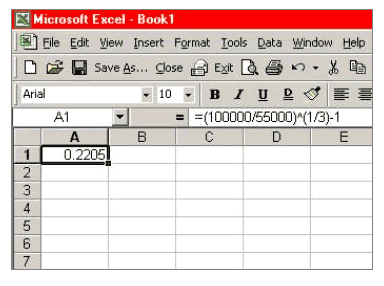
Instead of a financial calculator, you can use Microsoft Excel to find this result.
In a cell, enter “=(100000/55000)^(1/3)-1”, remember to type in the equal sign, all brackets and the slash, but not the quotation marks.
Press ENTER.
The result will be displayed as 0.2205 when you use a setting with 4 decimals.
Here is a picture of the Excel spreadsheet with that entry and setting.
The steps shown above may be repeated if you wish to calculate the geometric average rate of return over longer periods of time. For a 4-year period, use ¼ as the exponent, for a 5-year period use 1/5, and so on.
Knut Larsen, cand.oecon., CFP, FCSI, is a partner at the Brigus Group. Prior to joining the Brigus Group, he was academic affairs director at IFIC and the Canadian Institute of Financial Planning (CIFP).